Procuring heavy-duty machinery for the aerospace, shipbuilding, and energy sectors remains a high-stakes decision. A single equipment failure or precision error cascades into catastrophic project delays. Industrial facilities must mitigate these risks carefully. They rely heavily on specialized solutions tailored for extreme environments. The HJ151 Series stands out within the broader category of open-die equipment. We designed this article to provide a strictly technical, evidence-based evaluation. Our goal is to examine its operational capabilities and implementation realities in detail. You will learn how this machinery handles high-tonnage applications effectively. By the end, you will understand exactly how to assess its suitability for your specific manufacturing goals.
Key Takeaways
Core Application: The HJ151 series is engineered for high-precision, large scale metal forming, excelling in environments requiring deep material penetration and variable stroke control.
Structural Integrity: Utilizes a rigid frame or multi-column design to manage eccentric loads and maintain sustained pressure during prolonged forging cycles.
Implementation Reality: Requires significant site preparation, including custom foundation pits and dedicated hydraulic cooling infrastructure.
Evaluation Baseline: Shortlisting this equipment should depend on your facility's specific workpiece-to-tonnage ratio, automation readiness, and continuous operational demands.
Traditional mechanical alternatives often fail during intense forging operations. Mechanical equipment lacks constant force delivery throughout the entire stroke. Operators cannot adjust stroke parameters dynamically on mechanical setups. This rigidity severely limits your ability to process massive, complex ingots. Heavy-duty forging success requires an entirely different operational baseline.
First, you need consistent deformation across massive workpieces. Achieving uniform grain structure from the surface to the core is critical. You also require high-frequency operation capability to keep production schedules moving. Maintaining momentum ensures workpieces do not require constant reheating. Strict dimensional tolerances remain non-negotiable for critical aerospace and marine components.
Material variables add another distinct layer of operational complexity. Forming high-alloy steels and titanium demands immense, sustained pressure. These tough aerospace alloys strongly resist thermal deformation. They cool rapidly during handling, changing their metallurgical properties mid-cycle. Only a specialized free forging hydraulic press provides the sustained pressure required. It delivers deep, consistent material penetration without fracturing the costly workpiece. Operators can adjust the penetration depth instantly based on real-time material feedback.
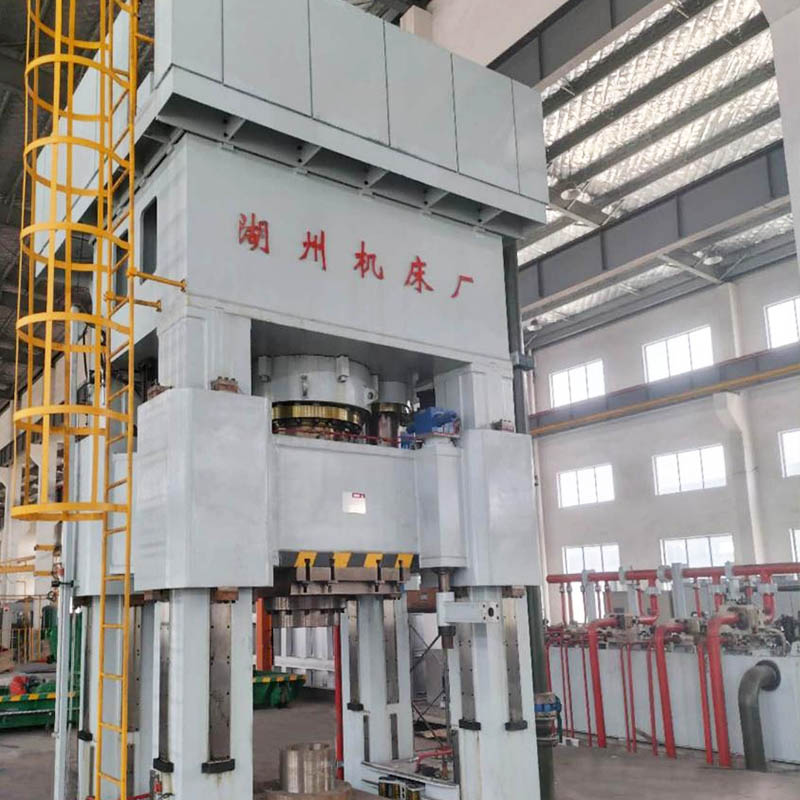
Engineering Architecture of the HJ151 Series Forging Press
Evaluating this machinery requires a deep dive into its structural engineering. The HJ151 forging press boasts impressive tonnage and stroke dynamics. Its fluid drive system delivers maximum pressing force constantly. You get peak power at any exact point in the working stroke. This contrasts sharply with mechanical alternatives. Mechanical options only achieve peak force at bottom dead center.
The frame and guiding system provide essential structural rigidity. Engineers designed it using a robust multi-column or heavy-duty housing architecture. This structural framework strongly resists deflection during intense processing cycles. A rigid frame prevents critical guiding inaccuracies. It ensures stability when the metal forming press handles severe off-center loads. Multi-column stress distribution prevents premature wear on critical moving parts.
Advanced fluid and control systems serve as the machine's brain. Manifold blocks, proportional logic valves, and intelligent pump configurations work together. Advanced PLC integration orchestrates these components seamlessly. Proportional logic valves adjust fluid flow instantaneously. You can program exact dwell times at the bottom of the stroke. This dwell time allows the material grain structure to settle properly. You achieve precise speed control and ultra-rapid return strokes. Rapid return strokes minimize the time hot metal spends outside optimal temperatures.
Automation compatibility is an absolute requirement for modern facilities. This machinery integrates flawlessly with robotic handling units. It connects easily to rotary tables and quick tool-change mechanisms. This automation synergy is mandatory for efficient large scale metal forming. Seamless integration significantly reduces material handling time and increases overall factory throughput.
Implementation Realities: Risks, Costs, and Rollout
Deploying industrial heavy machinery requires comprehensive logistical planning. Site preparation demands significant attention before the equipment arrives. You cannot place the HJ151 series on a standard concrete factory floor. It requires customized, deep reinforced concrete foundation pits. Foundation pits often extend several meters underground. Engineers must calculate the soil bearing capacity precisely. You must install advanced vibration isolation damping pads. Facilities also need substantial ceiling height clearance for overhead cranes.
Maintenance dependencies present an ongoing operational reality. High-pressure systems require exceptionally strict, scheduled upkeep. Fluid filtration must be managed meticulously to prevent particulate damage. Seal degradation happens naturally under high temperatures and extreme fluid pressures. Dedicated cooling infrastructure is absolutely mandatory. You might need external water chillers or large air-cooled heat exchangers. Unmanaged heat destroys fluid viscosity quickly.
Consider the operator adoption curve carefully during deployment. Transitioning veteran operators to digital PLC interfaces takes structured time. They must learn new touch-screen controls efficiently. Meanwhile, they need to maintain their traditional processing intuition. Training programs should bridge the gap between manual craftsmanship and digital precision.
Energy consumption profiles vary drastically during normal operation. The machinery draws massive electrical power during peak pressing cycles. However, power usage drops to minimal levels during idle states. Integrated energy-saving servo systems modulate pump speeds based on demand. This servo integration significantly stabilizes your overall electrical load.
Best Practices and Common Mistakes
Best Practice: Install redundant cooling loops to ensure continuous operation during unexpected thermal spikes.
Common Mistake: Underestimating the ambient temperature impact on system components. Facilities often install equipment without adequate HVAC ventilation overhead. This oversight leads to chronic overheating during summer production months.
Key Evaluation Criteria for Free Forging Presses
Establishing an authoritative evaluation framework ensures optimal machinery selection. First, carefully analyze tonnage-to-workpiece alignment. You must calculate the actual required force accurately. Base calculations on material yield strength, processing temperature, and contact area. Overestimating tonnage wastes capital upfront. Underestimating it leads to incomplete workpiece penetration and rejected parts.
Eccentric load handling serves as another critical performance metric. A dedicated free forging press must withstand severe off-center forces. Complex asymmetric parts push force away from the machine's central axis. Poor eccentric load capacity leads to rapid column wear.
Balancing control precision against cycle speed requires careful consideration. You need micro-millimeter precision for exact part dimensions. Yet, you also need high blow rates per minute (BPM). Fast BPM prevents the hot material from cooling prematurely.
Safety and compliance remain paramount across all heavy industries. Assess mandatory safety features thoroughly before finalizing any purchase. Every industrial forging press must include integrated light curtains. System interlocks and emergency depressurization protocols are non-negotiable. These safety protocols must conform strictly to global heavy machinery standards.
Best Practices and Common Mistakes
Best Practice: Conduct finite element analysis (FEA) to simulate load distribution before processing new part geometries.
Common Mistake: Ignoring eccentric load limits during asymmetric forming. Operators sometimes position odd-shaped ingots too far off-center. This error accelerates column scoring and ruins expensive brass guide bushes.
Evaluation Metric Summary
Evaluation Category | Key Metrics to Assess | Potential Operational Risks |
Tonnage Alignment | Material yield strength, contact area, temperature drop | Incomplete core penetration, internal voids |
Eccentric Loading | Maximum off-center force tolerance, frame deflection | Premature guide wear, uneven dimensional output |
Cycle Speed (BPM) | Fast approach speed, rapid return time | Excessive material cooling, higher reheat cycles |
Safety & Compliance | ISO standards, system interlocks, E-stop response | Operator injury, non-compliance fines, unplanned downtime |
Shortlisting Logic: Is the HJ151 Series Right for Your Facility?
Determining if this equipment fits your operation requires objective analysis. We must examine the ideal and sub-optimal use cases honestly. Facilities processing low-to-medium volume, highly customized large forgings represent the ideal fit. In these environments, stroke flexibility is absolutely non-negotiable. The machine adapts to varying part geometries on the fly. It handles marine propeller shafts and turbine discs perfectly.
Conversely, this equipment might be a sub-optimal fit for high-volume operations. Facilities producing uniform small parts need a different approach. A mechanical alternative or dedicated closed-die setup offers faster cycle times. Repetitive, identical shapes do not require variable stroke flexibility.
If the machinery aligns with your production goals, follow these next evaluation steps:
Request detailed specification sheets matching your exact operational requirements.
Arrange a site visit to observe an active installation closely.
Conduct a sample forming simulation using your specific alloy parameters.
Consult structural engineers regarding your facility's foundation limits.
Conclusion
Upgrading your facility's heavy machinery demands highly strategic foresight. The HJ151 series plays a pivotal role in handling complex materials. It offers superior force control and remarkable adaptability for specialized industries. However, its operational success depends heavily on proper infrastructure alignment. You must prepare the installation site adequately and train your operators thoroughly. We strongly advise technical buyers to consult directly with application engineers. Map the machine specifications directly to your exact ingot dimensions. Align the operational capabilities with your specific alloy types. This rigorous due diligence ensures your investment delivers optimal long-term performance.
FAQ
Q: What distinguishes a free forging hydraulic press from a closed-die press?
A: Open-die equipment utilizes flat or simply shaped tooling. The hot material flows freely laterally between the dies during compression. This approach offers immense flexibility for shaping massive, custom ingots into various forms. Conversely, closed-die equipment forces metal into enclosed cavities. The material completely fills a pre-cut mold. Closed-die machines produce highly uniform, near-net-shape parts rapidly but lack dimensional flexibility.
Q: What are the foundation requirements for the HJ151 forging press?
A: Installation requires engineered concrete foundation pits extending deep underground. You must incorporate heavy-duty vibration damping materials. The foundation isolates intense shockwaves from the surrounding factory floor. Engineers calculate load-bearing concrete specifications based on the machine's specific tonnage rating. Inadequate foundations cause rapid structural settling and critical machine misalignment.
Q: Can the HJ151 series integrate with existing forging manipulators?
A: Yes, the machinery integrates seamlessly with modern handling equipment. Advanced PLC handshaking protocols synchronize press strokes directly with manipulator movements. This digital synchronization allows rapid rotation and repositioning of the workpiece between blows. Proper automation readiness reduces handling time significantly. It prevents hot ingots from cooling excessively outside the furnace.
Q: What is the typical maintenance interval for the hydraulic systems on large scale metal forming presses?
A: High-pressure systems demand strict maintenance intervals. Operators should conduct daily visual checks for fluid leaks and abnormal pump noises. Facilities must perform monthly fluid analysis to monitor particulate contamination and viscosity degradation. Annual preventative maintenance includes comprehensive seal replacements and proportional valve recalibration. Strict adherence prevents catastrophic, unplanned production downtime.


