
- All
- Product Name
- Product Keyword
- Product Model
- Product Summary
- Product Description
- Multi Field Search

Views: 388 Author: Site Editor Publish Time: 2026-06-15 Origin: Site


The industrial landscape is rapidly shifting toward lightweight, high-strength manufacturing. We see this evolution distinctly in the aerospace and automotive sectors. However, carbon fiber reinforced plastic (CFRP) production faces significant bottlenecks. Manufacturers constantly battle long cycle times. They struggle against uneven resin distribution. Complex thermal management requirements further complicate daily operations. Overcoming these hurdles requires highly precise machinery. Selecting a precision composite material hydraulic press is not just a standard capacity upgrade. It acts as a critical requirement for achieving consistent part density. It ensures you maintain strict geometric tolerances on every single run. Standard equipment simply cannot deliver the necessary micro-level control. In this article, you will discover how modern solutions address these pressing manufacturing challenges. We will introduce the HJ078 series as a specialized, high-rigidity solution. You will learn exactly how its architecture meets the rigorous demands of modern composite molding. We also outline crucial procurement strategies for your engineering teams.
Precision Control: Active slider parallelism and multi-stage preloading eliminate wall-thickness variances and ensure uniform part density.
Process Versatility: Fully compatible with thermosetting and thermoplastic materials (SMC, BMC, LFT-D, HP-RTM).
Operational Efficiency: CNC servo press architecture significantly reduces energy consumption, lowers noise, and enables rapid automated changeovers.
Risk-Free Procurement: High-end manufacturers offer comprehensive pre-shipment mold testing, transparent lifecycle management, and customized tonnage configurations.
Advanced composite manufacturing pushes traditional machinery beyond its physical limits. Standard presses frequently fail in these demanding environments. They cannot manage the dual-purpose thermal profiles required by modern resin systems. You often see standard machinery execute a slow descent. This sluggish movement causes premature cooling of the material blank. The material cools before full pressurization begins. This timing error creates a cascade of structural defects. Standard machines also suffer from uneven force application. Uneven force leads directly to unacceptably high part rejection rates on the factory floor.
Microscopic tilting during the pressing phase creates severe consequences. Even a slight deviation causes uneven resin injection across the mold cavity. This inconsistency compromises the mechanical properties of the final complex-shaped component. It degrades the thermal resistance as well. A wall-thickness variance of just fractions of a millimeter can ruin the aerodynamic integrity of an aerospace part. You experience higher scrap rates. You waste expensive carbon fiber raw materials. Inconsistency ultimately damages your brand reputation for quality.
Engineers must set strict success criteria when upgrading equipment. You need a dedicated CFRP press engineered for high-speed transitions. Extreme structural rigidity is absolutely mandatory. It prevents frame deflection under massive loads. Micro-level pressure control is another critical requirement. It ensures the resin cures exactly as designed. Meeting these criteria guarantees repeatable precision across high-volume production cycles.
Modern composite molding relies on robust structural foundations. The framework must handle extreme stress. It cannot flex during operation. Heavy-duty frameworks prevent machine deformation under massive loads. The equipment utilizes a formidable three-layer composition. It features a top crown, vertical uprights, and a heavy bottom bed. High-tensile tie rods securely bind these components together. Engineers pre-tension these tie rods to withstand immense upward forces. This design guarantees exceptional stability over decades of use. Nominal pressure ranges are extensive and highly customizable. They scale from 1,000 kN up to 120,000 kN. This range easily matches varying production demands across different industries.
Traditional continuous-run hydraulics are rapidly stepping aside. We now see a dominant shift toward oil-electric servo control. An advanced CNC servo press delivers verifiable, evidence-based benefits. It provides rapid response times for complex pressing sequences. You will notice remarkably quiet operation on the factory floor. Decibel levels drop significantly compared to older models. Furthermore, the system adapts energy usage based on real-time load requirements. The servo motor slows down or stops during the long curing phase. This intelligent power management limits heat generation in the hydraulic oil. It extends the life of internal seals and pumps.
Speed is essential before the molding pressure applies. Integrated accumulators act as massive, pressurized energy reservoirs. They store hydraulic fluid under high nitrogen pressure. These accumulators allow for extreme fast-descent speeds. You need this rapid movement to prevent the heated blank from cooling. If the blank cools, the resin will not flow properly. As the tool approaches the material surface, the system seamlessly transitions. It shifts to safe, controlled work speeds precisely upon contact. This split-second timing requires highly responsive proportional valves.
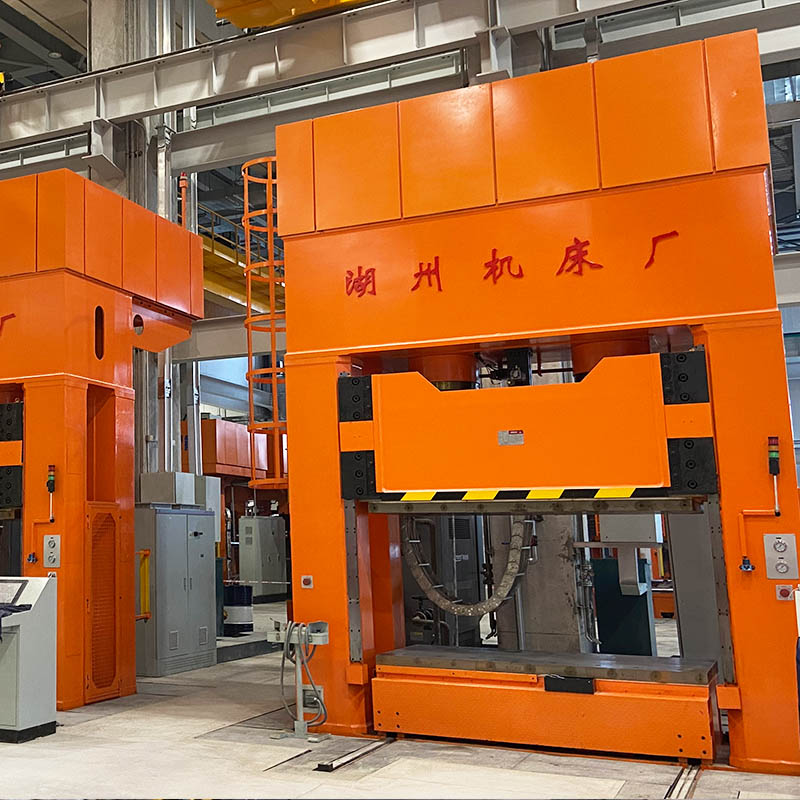
Ram tilt destroys component uniformity instantly. Multi-point high-precision leveling systems solve this exact problem. They actively monitor and adjust the slider during the downward stroke. High-resolution sensors detect the slightest deviations. They correct misalignments to microscopic tolerances. The system often corrects errors as small as 5/100 mm. This active intervention prevents the upper mold from tilting. It guarantees uniform density across the entire molded product. We consider this feature essential for large-panel production.
Curing resins naturally release trapped gases. A controlled micro-opening sequence allows these gases to safely escape. The machine slightly parts the mold for just a few seconds. Multi-stage preloading gently manages the material transition afterward. This sequence directly prevents surface burning. It dramatically improves the cosmetic finish of the final part. Operators frequently pair this sequence with vacuum degassed dies. The vacuum pulls out residual air. This combination guarantees structurally flawless results.
High-temperature matrix materials require exact thermal profiles to cure correctly. The equipment must seamlessly handle varied heating systems. This includes both direct electric heating platens and fluid-based mold temperature controllers. Precise temperature zones prevent premature curing. They ensure optimal resin flow into intricate mold cavities. High-quality thermal insulation boards sit between the mold and the machine platens. They stop heat from soaking into the main press structure. This insulation protects the machine frame from thermal expansion issues.
Factory throughput relies heavily on minimal floor downtime. Rapid pressure relief accelerates the post-cure extraction phase. Special decompression valves release hydraulic shock smoothly. Quick die change features transition heavy molds in minutes rather than hours. Hydraulic clamps and rolling bolsters simplify this task. These rapid transition capabilities reduce costly floor downtime. They integrate perfectly with automated handling systems. You can easily pair them with automated guided vehicles (AGVs) and robotic loaders.
Technical Capability | Control Mechanism | Direct Production Outcome |
|---|---|---|
Slider Parallelism Control | Sensor-driven proportional valves | Uniform part density and thickness |
Micro-Opening Sequence | Controlled hydraulic gas release | Elimination of surface burning |
Servo Drive Integration | On-demand power output | Low noise and high energy efficiency |
Quick Die Change | Hydraulic clamping & rolling bolsters | Higher overall factory throughput |
Versatility defines modern manufacturing success. A sophisticated composite material press must accommodate numerous advanced resin matrices. It cannot be limited to just one compound style. The equipment efficiently handles both powder and fiber-based composites. It maintains precise control over varying viscosity levels.
Supported industrial matrices include:
Sheet Molding Compound (SMC)
Bulk Molding Compound (BMC)
Glass Mat Thermoplastics (GMT)
Long Fiber Thermoplastics (LFT-D)
Prepreg Compression Molding (PCM)
High-Pressure Resin Transfer Molding (HP-RTM)
These distinct industries demand high-strength, lightweight structural parts. Strict regulatory compliance deeply governs their production environments. Exact mechanical and thermal properties remain absolutely non-negotiable here. A precision machine delivers the repeatable tolerances necessary to pass inspections. It easily meets stringent aerospace flight checks and automotive crash test standards. You will find these machines stamping out EV battery covers. They also form complex aerospace control surfaces and radomes.
Global energy infrastructure and sensitive electronics require highly specialized protective enclosures. We use a CFRP hydraulic press to create these corrosion-resistant components. These formed parts offer high-durability shielding for sensitive internals. The precise molding limits microscopic surface cracks. This perfection protects vital energy components from harsh environmental degradation. Telecommunication towers and wind turbine nacelles frequently rely on these composite housings.
Procurement teams face complex decisions when upgrading advanced facilities. A structured evaluation process minimizes your implementation risks. Engineers must define essential parameters clearly before speaking to vendors. You need a comprehensive specifications matrix.
This matrix must explicitly outline:
Nominal Force: The maximum required pressing tonnage for your largest part.
Daylight (Open Height): Maximum distance between platens to fit molds and automation tools.
Stroke Length: Total vertical travel distance of the main slider.
Table Size: Left-to-Right and Front-to-Back dimensions matching your dies.
Slide Speeds: Distinct velocities for fast descent, working stroke, opening, and return.
Partnering with reliable source factories is crucial for long-term success. You should thoroughly verify their internal 6S management practices. Demand transparent production updates throughout the entire manufacturing cycle. Ask for weekly video reports. This vigilance mitigates the risk of delayed delivery. It also prevents subpar assembly quality. True experts welcome factory audits and technical scrutiny.
Never accept an industrial machine without strict empirical validation. Emphasize the necessity of demanding free mold testing first. Conduct thorough trial production runs prior to signing the final acceptance document. Manufacturers call this a Factory Acceptance Test (FAT). These critical trials validate the machine's density claims. They also confirm that dimensional tolerances hold true under actual thermal loads. Bring your own raw materials to ensure absolute accuracy.
Heavy industrial equipment demands robust post-installation backing. Establish baseline requirements for global support early in the contract phase. Ensure the manufacturer provides 24-hour remote debugging capabilities. Secure Industrial Internet of Things (IIoT) connectivity makes this possible. Extended warranties and localized technician availability keep your lines running smoothly. Reliable support networks prevent minor faults from causing massive production halts.
Deploying a targeted composite molding machine fundamentally transforms your production floor. It directly correlates to substantially higher yield rates and better product consistency. You will notice noticeably reduced cycle times almost immediately. Ultimately, these operational efficiencies drive massive material savings by eliminating costly scrap. High-precision leveling, micro-opening sequences, and servo-driven power elevate your entire manufacturing baseline. Standard hydraulic systems simply cannot compete in this specialized arena.
We prompt engineering and procurement teams to take the next actionable step. Gather your latest product drawings and material specifications. Define your daily production volume targets clearly. Submit these detailed requirements to a trusted manufacturer today. Request a customized configuration and a comprehensive engineering analysis. Investing in the right technology secures your competitive edge in the rapidly growing composites market.
A: Tonnage calculation strictly depends on the projected surface area of the component. You must also factor in the material's specific flow characteristics. Engineers multiply the part's total surface area by the required molding pressure. Complex geometries or highly viscous resins require an additional safety factor of 10-20%. This buffer guarantees complete mold filling without starving the edges.
A: A micro-opening sequence slightly parts the mold halves during the initial heated curing phase. This precisely controlled gap allows trapped air to escape. It also releases volatile gases from the heated resin. Releasing these trapped gases entirely prevents internal voids. It stops surface burning, ensuring a structurally sound and cosmetically flawless finished product.
A: Yes, it seamlessly integrates into advanced existing lines. The system utilizes modern programmable logic controllers (PLCs). It communicates via standardized industrial protocols. This architecture allows it to synchronize effortlessly with automated guided vehicles (AGVs) and robotic loading arms. Such integration drastically reduces manual intervention and massively increases factory throughput.
A: Custom machinery typically requires a lead time of 4 to 6 months. Prior to shipment, the manufacturer conducts a rigorous trial validation. Clients submit their actual production molds and raw material batches. The factory runs sample cycles to verify dimensional accuracy. They check parallel control and cycle times before allowing final site acceptance.


