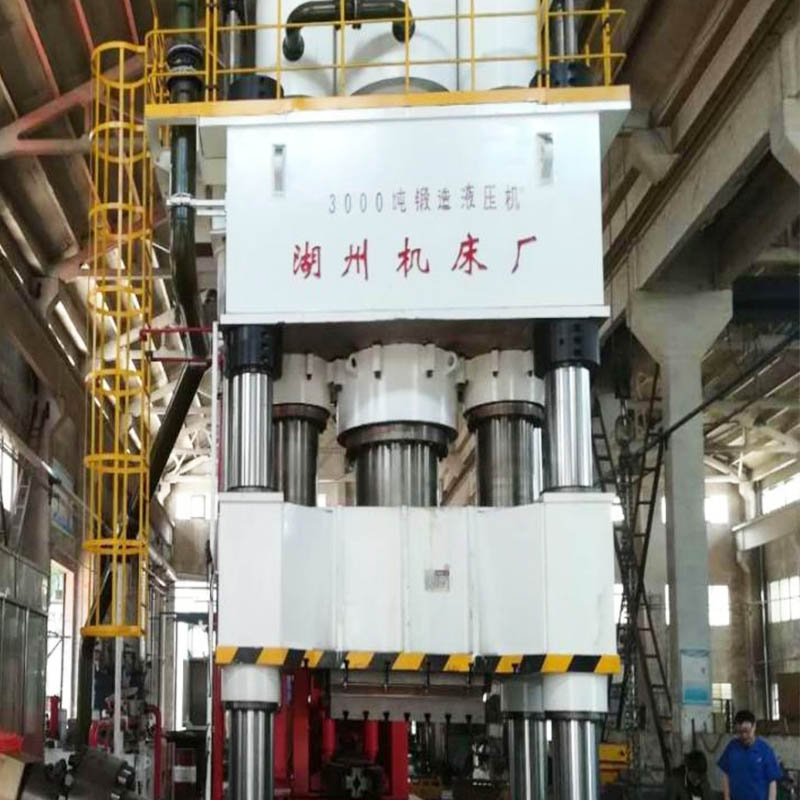
Producing large steel components requires immense, sustained force to control high yield-strength materials without introducing internal stress, metal tearing, or structural defects. Transitioning from small-scale manufacturing to large-part forging represents a fundamental shift in metallurgical control and process stability. Scaling up tonnage alone fails to address the physics of deep-penetration deformation. Heavy steel billets demand precise manipulation of heat and pressure to ensure uniform grain flow from the surface to the core.
Unlike mechanical alternatives that rely on flywheels and eccentric shafts, an industrial hydraulic press applies constant pressure throughout the entire stroke. This capability provides greater stroke control, allowing operators to manage the deformation rate precisely. Slower, sustained pressing allows the metal to flow naturally, making it the preferred forging press machine for large-part deformation.
This guide provides engineering and procurement teams with a technical framework to evaluate hydraulic forging press specifications, system configurations, and long-term production requirements in heavy metalworking and material processing.
Key Takeaways: Decision-Critical Factors
Dwell Time and Force Control: Understand why the ability to maintain consistent pressure (dwell time) is the primary hydraulic advantage for large steel parts, critical for uniform grain flow and overcoming yield strength safely.
System Versatility: Evaluating whether your production requires a specialized open die forging press for unique, low-volume heavy shapes or a closed die hydraulic press for high-volume, precision-formed components.
Infrastructure Reality: Heavy forging presses require significant pre-investment in foundation engineering, high-pressure fluid management, and auxiliary heating systems that must be budgeted alongside the machine cost.
Understanding Hydraulic Forging Press Mechanics for Large Components
Core Components and Force Transmission
The architecture of a heavy-duty press relies on fluid power mechanics to generate massive compressive forces. The primary system consists of the main cylinder, the piston (or ram), and the hydraulic power unit. High-pressure pumps drive hydraulic fluid into the main cylinder, forcing the piston downward against the workpiece. This design provides a relatively simple construction compared to complex mechanical linkages. Fewer moving mechanical parts translate to easier handling and maintenance, allowing for the reliable transmission of massive forces required to deform thick steel sections. The absence of a mechanical crankshaft eliminates the risk of catastrophic jamming at bottom dead center, a common failure point in mechanical systems handling oversized billets. Heavy-duty cylinders utilize multi-stage sealing arrangements to prevent fluid bypass under extreme pressure spikes, while bronze or composite guide bushings maintain ram alignment, absorbing lateral forces generated during asymmetrical forging operations.
The Principle of Constant Force
Hydraulic systems differ fundamentally from mechanical linkages in how they deliver power. A mechanical press generates its maximum rated tonnage only at the very bottom of its stroke. In contrast, fluid power systems achieve full tonnage at any point in the stroke. This principle of constant force is essential for deep-penetration forging. When working with large steel parts, the core of the billet remains highly resistant to deformation. Constant pressure overcomes the material's yield strength safely throughout the entire deformation cycle. Maintaining a steady, controlled speed prevents metal tearing and surface cracking, ensuring that the internal grain structure consolidates uniformly.
Operational Feature
Hydraulic Press System
Mechanical Press System
Force Availability
Full tonnage available at any point in the stroke
Peak tonnage available only at bottom dead center
Stroke Length
Fully adjustable based on workpiece height
Fixed by internal crankshaft geometry
Pressing Speed
Variable and programmable throughout the cycle
Fixed by flywheel momentum and motor speed
Overload Protection
Instant pressure relief via hydraulic valves
Requires mechanical shear plates or hydraulic tie-rod nuts
Energy Efficiency and Modern Hydraulics
Heavy forging operations consume massive amounts of electricity. Traditional hydraulic systems utilize constant-speed electric motors that run continuously, driving fixed-displacement pumps even when the press is idle or holding pressure. The industry has shifted toward servo-hydraulic controls. Servo motors adjust pump speed dynamically based on the exact flow and pressure requirements of the cycle. This reduces power consumption significantly during idle periods, loading phases, and dwell times. By eliminating the continuous bypass of high-pressure fluid, servo-driven systems generate less heat. Lower fluid temperatures reduce the load on industrial cooling circuits and extend the lifespan of hydraulic oil and elastomeric seals.
Precision and Programmability
Modern forging requires strict adherence to metallurgical recipes. Advanced PLC (Programmable Logic Controller) integration allows for precise ram positioning and velocity control. Proportional directional valves respond to PLC commands in milliseconds, adjusting fluid flow to dictate exact ram speeds during the approach, pressing, and return phases. This precision prevents over-forging or inconsistent material displacement. Operators program specific pressure profiles and dwell times, ensuring repeatability across multiple production shifts. Linear variable differential transformers (LVDTs) provide continuous feedback on ram position, closing the control loop and guaranteeing dimensional accuracy even under varying thermal conditions.
Classifying Systems: Open Die vs. Closed Die Configurations
Open Die Forging Press (Free Forging)
Open die forging involves deforming heated metal between flat or simply contoured dies that do not completely enclose the material. This process is highly operator-dependent and requires continuous manipulation of the workpiece.
Best-use case scenarios: This configuration is utilized for custom, low-volume, large-scale shafts, heavy rings, and massive structural bars. It is the only viable method for components weighing several tons that exceed the physical capacity of closed die systems.
Operational flexibility: An open die forging press handles varying geometry and material sizes without expensive tooling changes. A free forging hydraulic press allows facilities to pivot rapidly between different product types. Operators can perform drawing, upsetting, and punching operations on the same machine simply by changing the flat dies or utilizing hand tools.
Closed Die Forging Press (Impression Die)
Closed die forging forces hot metal into custom-machined die cavities, creating near-net-shape components with excellent structural integrity.
Best-use case scenarios: This method dominates high-volume production runs where dimensional accuracy and repeatability are non-negotiable. It is heavily utilized in aerospace, automotive, and energy sectors for producing gears, connecting rods, and turbine discs.
Tooling integration: A closed die forging press requires sophisticated tooling setups. Synchronized ejection systems remove the tightly wedged part from the die cavity immediately after the stroke. Die heating controls manage thermal expansion and prevent the dies from chilling the workpiece prematurely. The tooling stack often includes upper and lower die sets, guide pins, and wear plates that must withstand thousands of high-pressure cycles.
Multi-Directional Forging Press
Standard presses apply force along a single vertical axis. Multi-directional systems utilize horizontal rams in conjunction with the main vertical ram to deform the material from multiple angles simultaneously.
Applications for complex geometry: A multi directional forging press is engineered for complex valve bodies, heavy cross fittings, and intricate aerospace bulkheads. By applying force from three or four sides, multi-axis systems reduce the number of heats required. This improves material yield by minimizing flash and enhances structural integrity by aligning the grain flow precisely with the component's load-bearing contours.
Hot vs. Cold Forging Capabilities
The temperature at which deformation occurs drastically alters the machine requirements and the final material properties.
Process selection: Traditional hot forging is required for massive steel billets. Heating the steel above its recrystallization temperature lowers its yield strength, allowing large-scale plastic deformation without fracturing. Conversely, the specialized use of a cold forging hydraulic press transforms raw metal into high-strength, near-net-shape components without heating. Cold forging induces strain hardening, significantly increasing the tensile strength of the final part, though it requires exponentially higher tonnage for the same volume of material displacement.
Critical Specifications for Evaluating Heavy-Duty Hydraulic Presses
Tonnage Requirements
Determining the correct press capacity is the most critical engineering decision. Tonnage cannot be guessed; it must be calculated based on the material's flow stress at the target forging temperature, the projected surface area of the final part, and the friction factor between the die and the workpiece. Calculating the deformation force requires understanding that as a part flattens and its surface area increases, the required tonnage spikes dramatically. Undersizing the press results in incomplete die fill and internal voids, while oversizing leads to unnecessary capital expenditure and higher operational energy consumption.
To accurately determine the required tonnage, engineering teams follow these specific calculation steps:
Identify the flow stress of the specific steel alloy at the exact forging temperature.
Calculate the maximum projected surface area of the component at the end of the forging stroke.
Apply a complexity multiplier based on the die geometry (simple flat dies require lower multipliers than complex, deep-ribbed closed dies).
Factor in the friction coefficient between the hot steel and the lubricated die surface.
Add a 20% safety margin to account for temperature loss during transfer and pressing.
Stroke and Daylight Opening
The physical dimensions of the press frame dictate what can be manufactured. The daylight opening is the maximum vertical distance between the press bed and the ram when fully retracted. The stroke is the maximum distance the ram can travel. Evaluating the physical constraints of the press frame ensures it accommodates the largest intended workpiece, the necessary die heights, and the clearance required for loading and unloading via manipulators. For deep-drawing or long-shaft forging, an extended stroke is mandatory. Insufficient daylight renders the machine useless for tall components, regardless of its tonnage capacity.
Ram Speed and Control
Cycle time and metallurgical quality are often at odds in heavy forging. The hydraulic circuit must balance the trade-off between fast approach speeds for cycle time efficiency and slow, controlled pressing speeds for optimal material flow management. Fast approach speeds minimize the time the hot billet spends resting on the bottom die, reducing heat transfer and preventing chilling. Once the die contacts the material, the pressing speed must slow down. Rapid impact causes the exterior of the steel to deform faster than the core, leading to internal shear bands and structural defects. Advanced hydraulic manifolds utilize pre-fill valves to drop the ram quickly under gravity, then seamlessly transition to high-pressure pump flow for the actual pressing phase.
Structural Rigidity
Applying thousands of tons of force exposes the press frame to extreme stress. Maintaining structural rigidity is paramount. Frame rigidity is essential for maintaining parallelism under off-center loading conditions. If a billet is placed slightly off-center, the reaction forces attempt to tilt the ram. A rigid frame resists this deflection, ensuring the dies close perfectly parallel. Excessive deflection causes premature die wear, dimensional inaccuracies in the forged part, and severe scoring on the main cylinder guide bushings.
Frame Type
Construction Method
Best Application
4-Column (Tie-Rod)
Four heavy steel columns guiding the moving platen, secured with massive pre-tensioned nuts.
Open die forging, large bed area requirements, easy access from all four sides.
Monolithic (Solid Frame)
Single-piece cast or heavily welded steel plate construction.
High-precision closed die forging, extreme rigidity requirements, smaller bed sizes.
Infrastructure and Production Environment Requirements
Foundation Engineering
A heavy forging press cannot simply be bolted to a standard factory floor. The installation requires specialized, deep-pit foundations designed by civil engineers. These massive concrete structures are isolated from the rest of the building floor to mitigate shock and vibration. The foundation must bear the static weight of the machine and absorb the dynamic shockwaves generated during rapid decompression and heavy pressing. Constructing these deep-pit foundations involves extensive soil testing, excavation, heavy rebar reinforcement, and specialized spring-viscous damping pads. This civil engineering work requires months of preparation before the machine arrives on site.
Auxiliary Equipment Integration
The press is only one component of a continuous thermal and mechanical process. Efficiency relies entirely on the surrounding auxiliary systems.
Forging Manipulators: Handling white-hot steel billets weighing several tons requires specialized mobile equipment. Syncing press controls with heavy-duty manipulators is critical for open die forging. The manipulator grips, rotates, and advances the billet in perfect coordination with the ram strokes. Modern setups link the manipulator's PLC directly to the press, automating the step-forging process and eliminating human timing errors.
Heating Systems: Steel must be forged within a specific temperature window to ensure proper grain refinement and prevent cracking. Requirements for induction heating or gas furnaces must be integrated into the workflow. The furnaces must be positioned close enough to the press to minimize heat loss during transfer. For large parts, reheating may be necessary mid-process, demanding precise logistical coordination between the furnace operators and the press crew.
Fluid Management and Filtration
The lifeblood of any hydraulic system is its fluid. The critical nature of hydraulic oil maintenance cannot be overstated. High-tonnage systems operate at extreme pressures, forcing oil through tight valve clearances. Contamination control is the single biggest factor in preventing unplanned downtime. Microscopic metal shavings, dust, and degraded oil molecules act as abrasives, scoring cylinder walls and destroying proportional valve spools. Facilities must implement rigorous fluid management protocols, including offline kidney-loop filtration systems, desiccant breathers to prevent moisture ingress, and regular oil sampling to monitor particulate counts according to ISO cleanliness standards. In environments with extreme fire risks, specialized water-glycol fire-resistant fluids replace standard mineral oils, requiring specific seal materials and pump designs.
Risk Mitigation and Quality Assurance in Forging Operations
Thermal Management
Forging large steel parts transfers immense heat directly into the tooling. Managing die heat is critical to prevent thermal fatigue, heat checking, and catastrophic die cracking. Facilities ensure the longevity of high-cost tooling by implementing automated die lubrication and cooling spray systems. These systems apply graphite-based lubricants that reduce friction and create a thermal barrier between the hot billet and the die steel. Dies are pre-heated before the first strike to reduce the thermal shock of contacting a 1200°C steel billet.
Safety Protocols
Operating machinery capable of crushing massive steel blocks presents severe hazards. Implementing comprehensive safety protocols is mandatory. Modern presses are equipped with redundant safety systems. Light curtains create an invisible barrier around the working envelope, instantly halting the ram if an operator breaches the perimeter. Pressure relief valves prevent the hydraulic circuit from exceeding safe design limits. Mechanical safety blocks are physically inserted under the ram during tooling changes to prevent gravity-induced drops. Emergency dump systems rapidly depressurize the main cylinder in milliseconds if a critical failure is detected, protecting both the operators and the machine structure during high-force operations.
Data-Driven Quality Control
Visual inspection is insufficient for verifying the internal integrity of large forged components. The role of integrated sensors for monitoring force-displacement curves in real-time has transformed quality assurance. By mapping the exact tonnage applied at every millimeter of the stroke, engineers can detect anomalies. A sudden drop in resistance might indicate an internal void or material shearing, while an unexpected spike could signal improper billet heating. Strain gauges mounted directly on the tie rods detect off-center loading in real-time, alerting operators before frame damage occurs. Capturing this data provides a permanent audit trail for the metallurgical integrity of every part produced.
Conclusion: Defining Your Shortlist
Forging large steel parts is highly capital intensive. The press must be viewed as the heart of a wider process ecosystem rather than an isolated machine. Success depends on the seamless integration of foundations, heating systems, manipulators, and fluid management protocols. Evaluating these systems holistically prevents bottlenecks and ensures the machine operates at its designed capacity. Prioritize vendors based on their ability to provide custom integration and local service response times rather than simply the initial machine price. A vendor that can supply the press alongside integrated automation, manipulators, and customized PLC programming reduces integration risks significantly.
To move forward with your procurement strategy, execute the following next steps:
Audit your current material throughput and geometry complexity to establish baseline production targets.
Calculate the maximum projected surface area and flow stress of your toughest alloys to define minimum tonnage requirements.
Measure your facility's ceiling height and floor load capacity to determine maximum allowable daylight and foundation constraints.
Request finite element analysis (FEA) simulations from tooling engineers to verify that your proposed tonnage can achieve full die fill.
Compile these metrics into a comprehensive technical specification document to evaluate all vendor proposals against your exact production realities.
FAQ
Q: Why is a hydraulic forging press preferred over a mechanical press for large steel parts?
A: Hydraulic presses offer constant force throughout the stroke, allowing for slower, more controlled deformation. This sustained pressure prevents structural defects and internal tearing in thick cross-sections, unlike mechanical presses that have a fixed stroke and deliver peak force only at the bottom dead center.
Q: How do I determine the tonnage required for my application?
A: Tonnage is determined by the material’s resistance to flow at forging temperature, the surface area of the part, and the deformation geometry. It is recommended to perform a finite element analysis (FEA) to calculate the exact required tonnage before procurement to ensure complete die fill.
Q: What are the primary maintenance challenges for an industrial hydraulic press?
A: The primary concerns are hydraulic fluid degradation, seal integrity under high pressure, and the mechanical wear of guidance systems. Preventative maintenance programs, offline kidney-loop filtration, and strict oil cleanliness monitoring are critical to minimizing unplanned downtime and extending component life.
Q: Can a single hydraulic press be used for both open and closed die forging?
A: Yes, provided the press is designed with sufficient daylight, a large enough bed size, and the necessary control flexibility. However, efficiency may be lower than a dedicated machine, so you must evaluate your specific volume and tooling changeover requirements carefully.
Q: How does dwell time affect the quality of large forged parts?
A: Dwell time allows for uniform heat distribution and consistent material flow throughout the part. This sustained pressure is critical for complex, large steel components to avoid internal stress zones and surface cracking that frequently occur with rapid, high-impact forging methods.